Some of these links might earn us a commission. But don't worry - no amazon links here. We prioritize sharing direct link from the manufacturer or small local businesses.
My top picks for organic fertilizers:
As a homesteader and gardener, I understand the importance of using high-quality organic fertilizers to maintain soil health and promote thriving plants.
That's why I've personally worked with each of the following products and can confidently recommend them to anyone looking to enhance their gardening practices.
These fertilizers provide a host of benefits, from boosting soil health and microbial communities to avoiding the GHG emissions and pollution from synthetics. All of them are OMRI listed for organic agriculture.
If you're looking to take your gardening to the next level, consider trying one of my top picks for organic fertilizer in 2025.
Other organic fertilizers for vegetables that we use and love!
Affordable organic vegetable fertilizer, in pelletized form:
Nutri-Rich 4-3-2 Fertilizer Pellets (50 lb)
- 4N-3P-2K, also contains 7% calcium
- the pelletized form is great for applications on a windy day, where standard powder fertilizer would blow around
- does stay on surface and takes a few watering applications to visibly break down
Well-rounded and balanced vegetable fertilizer:
Down to Earth Vegetable Garden Fertilizer 4-4-4 (25 lb)
- 4-4-4 is a great choice for applying to almost any vegetable
- also contains calcium, magnesium, and iron
Best organic fertilizer for seedlings to use when transplanting (high phosphorus):
- 4-6-2 is great for leaf and root development
- addition of mycorrhizal fungi helps plants create beneficial relationships with fungi at the root level
- perfect for helping plants to get established if you apply it to the transplanting site and then again 2 weeks afterwards
Worm castings:
Peaceful Valley Organics Premium Earthworm Castings
Numerous studies have shown that vermicompost produces end yield and plant health results similar to chemical fertilizers, and sometimes even surpasses them (source). It also helps to enhance soil microbiology.
A study in 2020 found that vermicompost and vermicompost tea can effectively substitute synthetic fertilizers while also decreasing pest and disease, leading to an additional benefit of a reduced need for herbicides and pesticides (source).
Vermicompost is also a great way to keep green waste out of the landfill, as it’s what the worms will eat to make their castings.
Keep microbial nutrient relationships alive and benefit the planet with these organic fertilizers
Organic fertilizers vs inorganic fertilizers
If you decide that your plants need a health boost and you decide to fertilize, it’s important to make sure that your fertilizer is organic.
Organic fertilizer feeds the microbes that build relationships with plants to deliver nutrients to them. We want to foster this relationship!
On the other hand, synthetic fertilizer decreases the need for plants to form beneficial relationships with microbes - they don’t need their nutrients anymore (teaming with microbes).
In fact, organic fertilizer actually requires soil bacteria and fungi to make the nutrients bioavailable to the plants (source).
So organic fertilzer boosts soil health and microbial communities while synthetic fertilizer disrupts the soil food web.
There are other reasons as to why we want to only apply synthetic fertilizers to our crops.
Synthetic fertilizers have a high carbon footprint because they are typically made from petrochemicals (source).
Synthetic nitrogen fertilizers alone account for 2% of global GHG emissions. To put this into perspective, that’s the same amount released from commercial aircraft globally.
Moreover, synthetic nitrogen fertilizers emit nitrous oxide, which is 265 more potent than carbon dioxide (source).quote on soil health from Jeff Lowenfels in his book Teaming with Microbes
What does NPK mean?
NPK stands for nitrogen, phosphorus, and potassium, which are three essential nutrients for plant growth. They are often referred to as primary macronutrients. In a fertilizer's NPK rating, the numbers indicate the relative proportion of each nutrient in the product.
Nitrogen
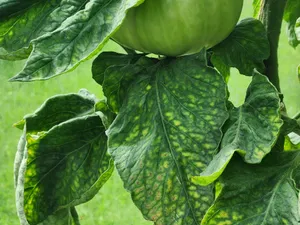
An essential nutrient for plant growth, especially the green leafy growth of plants. For a fertilizer's NPK rating, the N is the proportion of nitrogen within the product. Signs of nitrogen deficiency are pale to yellowing leaves and stunted growth.
Nitrogen is in the air, and some plants have a symbiotic relationship with organisms in the soil that help them to transform atmospheric nitrogen into a usable nutrient for the plant.
Phosphorus
An essential nutrient for plant growth, especially stem, root, and tuber development of plants. In a fertilizer's NPK rating, P is the proportion of phosphorus within the product.
Signs of phosphorus deficiency are small and misshapen tubers or roots of root crops or purple-tinged leaves (PennState + GlobalNet).
Potassium
Potassium helps with the fruiting and rooting of plants, supports water uptake, and enhances photosynthesis efficiency. In the NPK rating, K is the proportion of potassium within the product.
Signs of potassium deficiency are small and misshapen fruits or stressed plants (PDA).
What do the fertilizer numbers mean?
The numbers are how many pounds of each nutrient would be in a 100 pound bag. For example, a 4-4-4 blend has 4 pounds of nitrogen, 4 pounds of phosphorus and 4 pounds of potassium in 100 lb bag of that particular fertilizer (OSU).
Organic fertilizers - build fertility while supporting the planet
By choosing organic fertilizers over synthetic ones, you're not only helping to maintain healthy soil, but you're also reducing your carbon footprint and contributing to a healthier planet. Understanding the role of NPK and other essential nutrients for plant growth is a crucial step in selecting the right fertilizer for your garden. Our top picks for organic fertilizers in 2024 offer diverse benefits, from fast-acting formulas to slow-release options that promote long-term soil health. With these organic fertilizers, you can boost your garden's fertility while supporting a more sustainable future.